How much matcha per day is right for you?
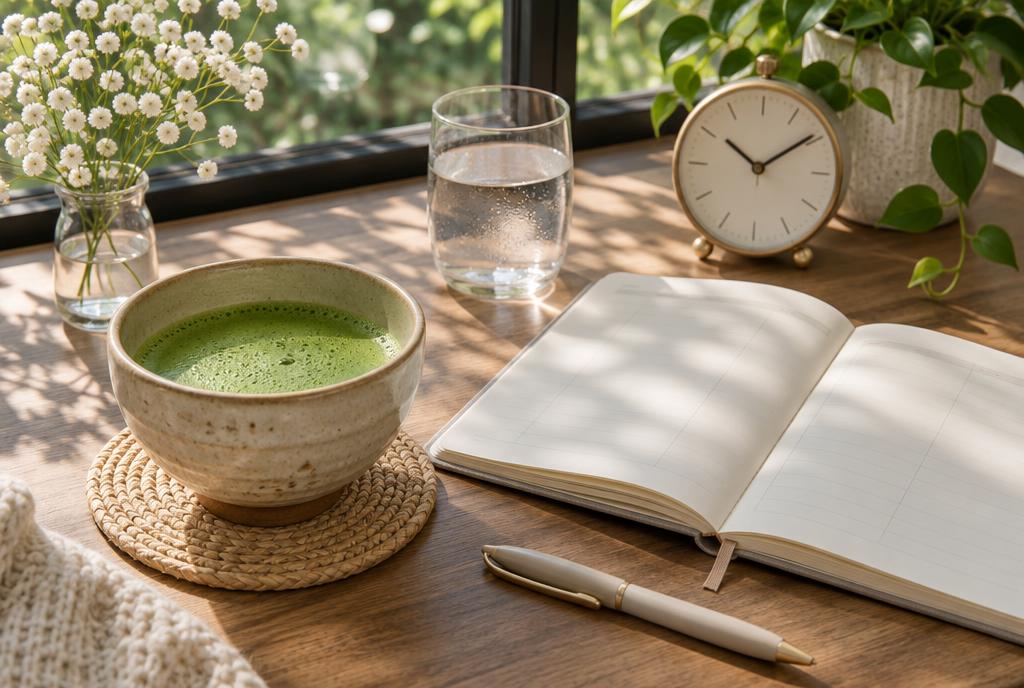
For most healthy adults, one to three bowls of matcha a day (2 g each) sits comfortably within official caffeine guidance, and many people find two is the sweet spot. How much matcha per day is right for you depends less on the tea itself and more on your total caffeine, how sensitive you are to it, and when in the day you drink it.
Below: the numbers behind that answer, how to count matcha alongside coffee and other drinks, who should keep it lower, and how to build a day of tea that still lets you sleep.

Shop this guide
LOW CAFFEINE 静 · Izumo, Shimane
For a second or third cup that keeps your daily caffeine low: 7 mg a cup*, smooth and naturally sweet.
Free shipping on Singapore orders with code FREESHIP.
The short answer: count caffeine, not cups
There is no official daily limit for matcha. There are limits for caffeine, and matcha is one source of it. So the useful question is how much caffeine each bowl carries, and how much you take in across the whole day.
The European Food Safety Authority (EFSA) says up to 400 mg of caffeine a day from all sources raises no safety concerns for healthy adults, and single doses up to 200 mg are fine for most. The US FDA uses the same 400 mg figure, describing it as an amount "not generally associated with negative effects" (FDA). Both note that people vary widely in how sensitive they are.
How much caffeine is in one bowl?
A standard bowl uses 2 g of matcha, two level 1 g spoons. Matcha is the whole leaf, ground, so you drink all of its caffeine rather than just what steeps out. How much that is varies with the cultivar, the harvest and the grade.
- Published range. A 2020 review in Molecules cites 18.9–44.4 mg of caffeine per gram of matcha (Kochman et al.). At 2 g, that is roughly 38–89 mg a bowl.
- Our reference figure. We use 64 mg per 2 g serving for regular matcha*.
- LOW CAFFEINE from Izumo. 7 mg a cup*, for the bowls where you want the ritual without much caffeine.
For comparison, Mayo Clinic gives about 96 mg for an 8 oz (about 240 ml) cup of brewed coffee and about 29 mg for brewed green tea. Our guide to matcha vs coffee caffeine goes through the comparison serve by serve.
What that means in bowls a day
Using the published range and our reference figure, here is roughly how bowls add up against the 400 mg guide for healthy adults. These are estimates, not targets.
| Bowls a day (2 g each) | Caffeine, published range | At 64 mg a bowl* | Within 400 mg? |
|---|---|---|---|
| 1 | 38–89 mg | 64 mg | Yes, with plenty of room |
| 2 | 76–178 mg | 128 mg | Yes |
| 3 | 114–267 mg | 192 mg | Yes, if little else |
| 4 | 152–356 mg | 256 mg | Close, once coffee or cola is added |
| 2 regular + 2 LOW CAFFEINE | about 90–192 mg | 142 mg | Yes, with room to spare |
| From Matcha x World | LOW CAFFEINE 静 for later bowls · RIN 凛 for the morning · Add RIN to cart | ||
The middle of the table is where most people settle. One or two bowls of regular matcha, perhaps a third in the afternoon, leaves room for the odd coffee or a square of chocolate without drifting near the upper guide.
Lattes and café drinks count too
A home latte uses the same 2 g as a bowl, so it counts the same. Café drinks are harder to judge. Some use more powder, larger cups or a double scoop, and a dirty matcha adds a shot of espresso on top. If you drink matcha out, count a large café latte as at least one full bowl, and possibly two.
Signs you have had too much
The FDA lists what too much caffeine can look like in adults: a faster heartbeat or palpitations, insomnia, anxiety, jitters, an upset stomach, nausea and headache. Mayo Clinic adds restlessness and nervousness as signals to cut back. These are caffeine effects, not something unique to matcha.
Many people find matcha feels steadier than coffee. One idea is that L-theanine, an amino acid found in shade-grown tea, softens the edge. The research is promising, and still early-stage, and most studies use isolated compounds rather than matcha. Our guide to L-theanine in matcha covers what those studies show. Either way, caffeine is caffeine: if you feel wired, have fewer bowls or switch the later ones.
Who should drink less
The comfortable daily range is lower for some people.
- Pregnancy and breastfeeding. EFSA sets 200 mg a day from all sources. The FDA suggests talking with your healthcare provider about how much is right for you.
- Children and teenagers. EFSA sets a lower level scaled to size, and health bodies advise against caffeinated drinks for very young children.
- People sensitive to caffeine, or taking medicines that interact with it. The FDA notes that some conditions and medications make people more sensitive. Ask your doctor or pharmacist.
- Anyone watching their iron. Tea polyphenols can reduce how much non-haem iron, the kind in plant foods, you absorb from a meal. Drinking matcha between meals helps. See matcha and iron absorption for timing.
Beyond caffeine: catechins and quality
Matcha is rich in catechins, especially EGCG. EFSA reviewed green tea catechins in 2018 and concluded that tea prepared in the traditional way is generally considered safe at the intakes usually seen in Europe. The concerns it raised were about concentrated food supplements, at 800 mg of EGCG a day or more, not about bowls of tea. The US National Center for Complementary and Integrative Health likewise reports no safety concerns for green tea as a drink in adults, with rare liver problems linked mainly to extract pills.
So the sensible line is simple. Enjoy matcha as a drink, and be wary of green tea extract capsules stacked on top.
Because you drink the whole leaf, it also makes sense to choose matcha that is independently tested. Every batch of ours is independently verified by SGS; our lab testing and quality page explains what is checked.
A calm day of matcha, in practice
Timing matters as much as the total. EFSA notes that a single 100 mg dose of caffeine close to bedtime may affect sleep in some adults. A pattern many people find easy to keep:
- Morning: one bowl of regular matcha. 2 g, 70 ml of water at about 80°C, whisked in a W motion for 15–20 seconds. If a bowl on waking feels sharp, have it with or after breakfast; our piece on matcha on an empty stomach explains why some people prefer that.
- Late morning or early afternoon: an optional second. A latte works well here: 2 g with 30 ml hot water and 150 ml steamed or oat milk.
- Mid to late afternoon: switch to LOW CAFFEINE. Same method, same ritual, 7 mg a cup* instead of 64 mg in regular matcha*. On a warm Singapore afternoon, make it iced: 2 g with 30 ml warm water, over ice, topped with 150 ml cold water.
- Evening: keep it gentle or skip it. If you want a warm cup after dinner, a LOW CAFFEINE bowl is the quieter choice.
Start with one bowl a day for a week. Notice how you sleep and how the afternoon feels. Then add a second if you want it.
Frequently asked questions
Is it OK to drink matcha every day?
For most healthy adults, yes. One to three 2 g bowls a day sits well within EFSA and FDA caffeine guidance, provided the rest of your caffeine is modest.
Is four cups of matcha a day too much?
Four 2 g bowls could add up to roughly 150–355 mg of caffeine, depending on the tea. That is under 400 mg on its own but close once coffee, cola or chocolate is added. If you like four, make the later ones LOW CAFFEINE.
How many grams of matcha is one serving?
Two grams, two level 1 g spoons, for a bowl of thin tea or a latte. Thick koicha uses more, so count it as more than one serving.
What is the latest time to drink matcha?
There is no fixed rule. Caffeine near bedtime can affect sleep for some people, so many find a cut-off in the early afternoon works for regular matcha.
Which matcha should I buy if I want more than one cup a day?
Keep a regular matcha for the morning and add LOW CAFFEINE, our first-harvest matcha from Izumo, Shimane, for later cups. It has 7 mg caffeine a cup*, a smooth, naturally sweet taste, and 15 cups to a 30 g tin. Keep cool and dry. Enjoy within a month of opening.
Find your number
The right amount is the one that leaves you clear in the afternoon and asleep at night. For many people that is a morning bowl of something bright and full, and a gentler one later. If your morning matcha is the one you look forward to most, start there.

For the morning bowl
RIN 凛 · Uji, Kyoto
Our ceremonial matcha for slow mornings, balanced straight and smooth in a latte, to pair with a quieter afternoon cup.
Calm Energy. One World.
*Per 2 g serving, lab tested. Regular matcha: Standard Tables of Food Composition in Japan.