Matcha vs coffee: caffeine, the crash and how much a day
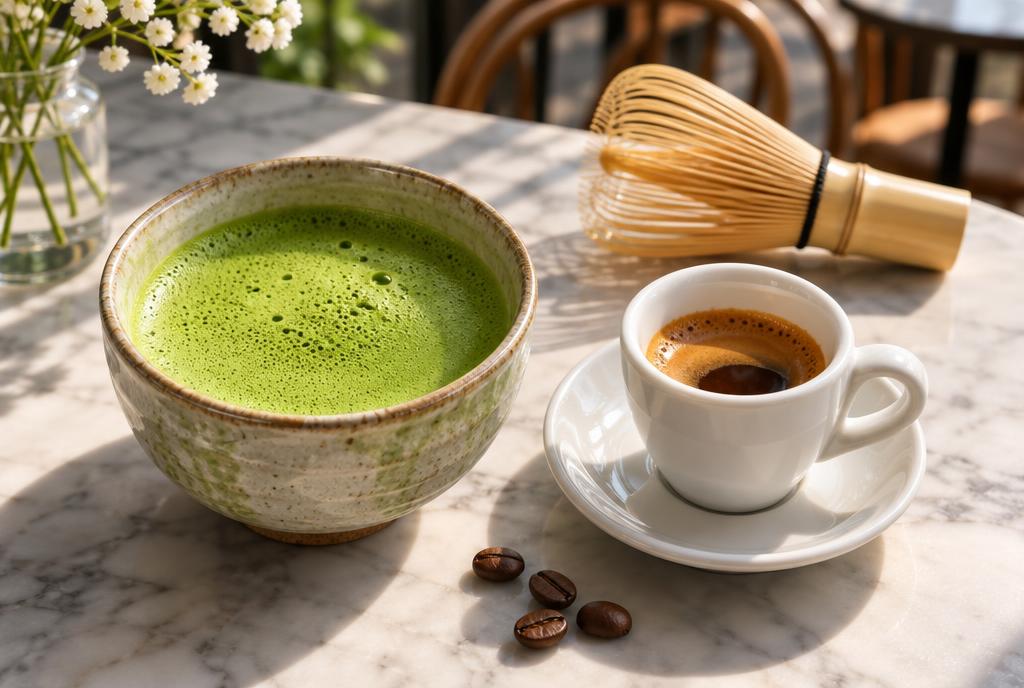
A 2 g serve of matcha usually carries somewhere between 38 and 89 mg of caffeine, while an 8 oz cup of brewed coffee averages about 96 mg. So on matcha vs coffee caffeine, the gap is smaller than many people expect: the bigger differences are how much you drink, how fast, and what comes with the caffeine.
This guide sets out the numbers per serve, what may make matcha feel different, how much a day sits within official guidance, and what to do if caffeine does not agree with you.

Shop this guide
LOW CAFFEINE 静 · Izumo, Shimane
For anyone cutting back: first-harvest matcha with 7 mg caffeine a cup* against 64 mg in regular matcha, smooth and naturally sweet.
Free shipping on Singapore orders with code FREESHIP.
Matcha caffeine per serve
Matcha is the whole leaf, ground to powder, so you drink all of its caffeine rather than the share that dissolves into water. That makes it stronger per gram than steeped green tea, and more variable than most labels suggest.
- Published range. A 2020 review in Molecules cites analyses of roughly 19 to 44 mg of caffeine per gram of matcha. At 2 g, that is about 38 to 89 mg a bowl.
- Our reference figures. Regular matcha contains 64 mg per 2 g serving*. LOW CAFFEINE, our first-harvest matcha from Izumo, contains 7 mg per 2 g serving*.
- What moves the number. Grade, harvest, leaf age and, above all, how much powder goes in. A home bowl uses 2 g. Some café drinks use more, so a large matcha drink may carry more caffeine than you assume.
Coffee caffeine per serve
The Mayo Clinic caffeine table lists about 96 mg in an 8 oz (237 ml) cup of brewed coffee and about 63 mg in a 1 oz (30 ml) espresso. Brewed green tea comes in near 29 mg per 8 oz. Real cups vary with the bean, the roast, the brew and the size of the mug, and many takeaway coffees are well over 8 oz.
Matcha vs coffee: the comparison
| Drink | Typical serve | Caffeine | Share of a 400 mg day | From Matcha x World |
|---|---|---|---|---|
| Brewed coffee | 8 oz (237 ml) | about 96 mg | about 24% | A gentler swap: LOW CAFFEINE |
| Espresso | 1 oz (30 ml) | about 63 mg | about 16% | A whisked bowl instead: KIWAMI |
| Brewed green tea | 8 oz (237 ml) | about 29 mg | about 7% | For a fuller cup of the whole leaf: KIWAMI |
| Matcha, published range | 2 g | about 38–89 mg | about 10–22% | KIWAMI, first harvest from Yame |
| Regular matcha (Japanese food tables) | 2 g | 64 mg* | 16% | KIWAMI, full caffeine |
| LOW CAFFEINE | 2 g | 7 mg* | under 2% | LOW CAFFEINE from Izumo · Add LOW CAFFEINE to cart |
Coffee and espresso figures from the Mayo Clinic; matcha range from published analyses. If you combine the two, as in a dirty matcha with espresso, add both numbers together.
Why matcha may feel different
Many people find matcha gives a smoother, steadier alertness than coffee. There are a few plausible reasons, and it is worth being careful about each.
L-theanine
Shaded tea leaves build up L-theanine, an amino acid. Lab studies that paired around 100 mg of L-theanine with 40 to 50 mg of caffeine found small gains in attention and self-rated alertness over the following hour or so. But a 2014 meta-analysis found the effects followed the caffeine dose more closely than the theanine dose, and these studies used isolated compounds, not matcha. The effect is promising, and still early-stage. Our guide to the science of matcha benefits goes through these trials in detail.
Dose and pace
A 70 ml bowl of matcha often holds less caffeine than a large mug of coffee, and people tend to sip it slowly. Less caffeine arriving more gradually may simply feel gentler.
A claim we leave out
You may read that matcha's caffeine is "released slowly" because it binds to other compounds in the leaf. We have not found good human evidence for that, so we do not repeat it.
The matcha crash, and the coffee crash
There is little research on the "crash" itself. What people describe is usually caffeine wearing off, poor sleep catching up, or a sugary drink dropping away. Café matcha lattes can be heavily sweetened, which muddies any comparison.
A few habits help, whichever drink you choose:
- Have caffeine earlier in the day. EFSA notes that a single 100 mg dose may affect sleep in some adults, especially close to bedtime.
- Drink it with or after food if that sits better with you. Some people find matcha gentler that way.
- Skip or reduce the syrup. A plain matcha latte with steamed or oat milk needs none: 2 g matcha, 30 ml hot water and 150 ml milk.
- Switch your afternoon cup to a lower-caffeine bowl rather than a second coffee.
How much matcha per day
The European Food Safety Authority's caffeine guidance considers up to 400 mg a day, spread through the day, safe for healthy adults, with single doses up to 200 mg. The US Food and Drug Administration cites the same 400 mg as an amount "not generally associated with negative effects" for most adults.
In practice, at 64 mg per 2 g bowl*, one to three bowls of regular matcha keeps most healthy adults comfortably within that figure, leaving room for other sources. Count everything: coffee, tea, cola, chocolate and energy drinks all add up.
Sensitivity varies widely. The FDA lists jitters, a faster heart rate, an upset stomach, headaches and poor sleep among the signs of too much caffeine. If you notice them, it is worth cutting back.
Pregnancy and breastfeeding
EFSA's figure for pregnancy and breastfeeding is up to 200 mg a day from all sources. The FDA and Mayo Clinic both suggest talking with your doctor or midwife about whether you should limit caffeine. Please do that before setting your own number.
Children and teens
Younger people are more sensitive to caffeine. Regular matcha is best treated as an adult drink.
Choosing between them
If you love coffee and sleep well, there is no need to give it up. Matcha is simply another option, with a different flavour, a different ritual and, for some people, a different feel. If you are trying to drink less caffeine without losing the morning habit, a lower-caffeine matcha lets you keep the bowl and the whisk. Our morning matcha routine shows how to build that habit in a few minutes.
For a hot bowl at home, whisk 2 g (two level 1 g spoons) with 70 ml of water at about 80°C, in a W motion, for 15 to 20 seconds. Keep cool and dry. Enjoy within a month of opening.
Frequently asked questions
Does matcha have more caffeine than coffee?
Usually not per serve. A 2 g bowl of matcha has roughly 38 to 89 mg, against about 96 mg in an 8 oz brewed coffee. A large café matcha made with extra powder can come close to, or pass, a small coffee.
How many cups of matcha a day is too much?
For healthy adults, staying within 400 mg of caffeine from all sources is the official guide. At about 64 mg a bowl*, that leaves room for several, but one to three is a comfortable range for most people.
Can I drink matcha in the evening?
Regular matcha has enough caffeine to affect sleep for some people. A low-caffeine matcha is a better fit for later in the day.
Is matcha better than coffee for an empty stomach?
There is no clinical guidance either way. Some people find matcha sits better with or after food.
Which Matcha x World matcha has the least caffeine?
LOW CAFFEINE, our first-harvest matcha from Izumo, with 7 mg per 2 g serving*. 静 (sei) means stillness, and it drinks that way: smooth, gentle and naturally sweet. Our lab tested quality checks explain how we verify it. Every batch is independently verified by SGS.
A calmer cup
You do not need to choose a side. Know your numbers, notice how you feel, and pick the cup that suits the hour. When you want the full depth of first-harvest matcha in the morning, there is this.

For full-caffeine mornings
KIWAMI 極 · Yame, Fukuoka
A rarer first-harvest, stone-ground tin from Yame, with deep umami and very low astringency for drinking straight.
Calm Energy. One World.
*Per 2 g serving, lab tested. Regular matcha: Standard Tables of Food Composition in Japan.