Matcha benefits: what the science says so far
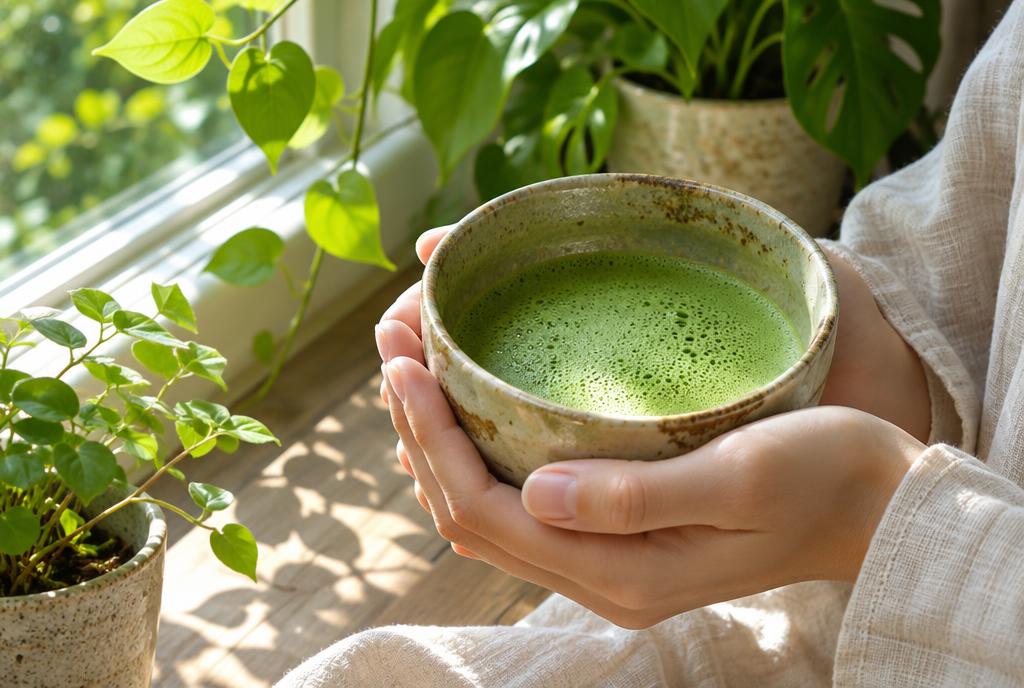
The best-supported matcha benefits are modest. A bowl brings caffeine and L-theanine together, and small trials suggest a slight, short-lived lift in attention, with early signs of lower stress. Most other claims rest on animal work or on studies of ordinary green tea, so the honest summary is this: promising, and still early-stage.
Matcha is the whole tea leaf, shaded before harvest, steamed, dried and stone-ground. You drink the leaf itself rather than water that has passed over it, which is why researchers find it interesting. Below is what the studies found, how strong each finding is, and where the evidence stops.

Shop this guide
RIN 凛 · Uji, Kyoto
If you want to taste the whole leaf in a plain bowl, this first-harvest, stone-milled matcha is sweet and rounded, with very little bitterness.
Free shipping on Singapore orders with code FREESHIP.
What is in matcha
Three groups of compounds explain most of the scientific interest.
- Catechins. These are green tea's main polyphenols, and EGCG (epigallocatechin gallate) is the most abundant. Because you drink the powdered leaf, a 2020 review in Molecules describes matcha as the most concentrated source of them among teas.
- L-theanine. An amino acid that builds up when tea plants are shaded for the weeks before picking. It is part of what gives matcha its savoury, umami depth.
- Caffeine. Analyses cited in the same review range from about 19 to 44 mg per gram, so a 2 g bowl lands somewhere between roughly 38 and 89 mg. Grade, harvest and leaf age all move the number.
Whole leaf cuts both ways. You take in everything the leaf holds, including anything it picked up from the soil. That is why independent testing matters, and why we publish our matcha lab testing results. Every batch is independently verified by SGS.
Calm focus: caffeine and L-theanine together
The most studied idea is that L-theanine smooths caffeine's edge. Many people find matcha gives a steadier kind of alertness than coffee, and there is some laboratory support for that feeling.
Trials from 2008 and 2010 gave healthy volunteers around 100 mg of L-theanine with 40 to 50 mg of caffeine. Within an hour or so, they were more accurate on attention-switching tasks and rated themselves more alert. A 2014 meta-analysis of 11 placebo-controlled studies found moderate effects in the first two hours, but the changes tracked the caffeine dose more closely than the theanine dose.
Two caveats matter. These studies used purified compounds, not matcha. And several were run by industry researchers.
Matcha itself has been tested far less. In a small Dutch trial, 23 adults were given 4 g of matcha as a drink or a snack bar. Compared with placebo, they were slightly quicker on basic attention tasks, with little change elsewhere and no change in mood. A fair reading: a small, short-term attention effect is plausible, and caffeine probably does much of the work.
If you want to see whether the effect is real for you, keep it simple. A plain bowl of thin whisked usucha tells you more than a sweet café drink, because nothing else is masking the tea.
Stress: early matcha trials
Researchers at the University of Shizuoka asked whether the balance of compounds matters. In mice, matcha only reduced signs of stress when caffeine and EGCG were low relative to theanine and arginine. In a small human trial of 39 students, anxiety was lower with a high-theanine test matcha than with placebo. Their conclusion was that the ratio, not just the amount of theanine, decides the effect.
A 2021 Japanese trial followed 51 adults aged 50 to 69 who took about 2 g of matcha a day in capsules for 12 weeks. The matcha group did better on a timed arithmetic task under mild stress and on one attention measure. Stress itself was not measured directly, the participants were habitual green tea drinkers, and some authors worked for the company that supplied the matcha.
Studies of L-theanine supplements, often 200 mg a day, report improvements in self-rated stress and sleep. That is several times more theanine than a bowl of matcha provides, so the results do not transfer neatly.
Our verdict: promising, and still early-stage. Many people find the slow act of whisking a bowl calming in itself, and science cannot yet separate the leaf from the ritual.
Heart markers: associations, not proof
The best-known evidence comes from large population studies of brewed green tea. The Ohsaki study followed 40,530 Japanese adults for up to 11 years. Those who drank more green tea had lower rates of death from cardiovascular causes, most clearly in women. A 2015 meta-analysis of 18 cohort studies reported a similar pattern.
These are associations. People who drink a lot of green tea may differ in many other ways, from diet to how much they walk. None of the studies tested matcha.
Controlled trials are thinner. A 2013 Cochrane review of 11 trials with 821 participants found small reductions in LDL cholesterol and blood pressure with green tea, but few studies fed each result, the findings were not stable, and the authors asked readers to treat them with caution. A 2022 critical review of matcha research noted that its effects on these markers have so far been studied mainly in animals.
So the evidence does not show that matcha protects the heart. If you have a heart condition, your doctor is the right guide.
Skin: mixed results
Skin claims are common and the trials disagree. A 2011 German study gave 60 women a green tea polyphenol drink providing about 1,400 mg of catechins a day, far more than a bowl of matcha. After 12 weeks their skin reddened less under a UV lamp. A 2015 UK trial of green tea extract capsules found no meaningful protection against UV redness after three months.
Both used concentrated doses, not matcha. Whatever you drink, it is not a substitute for sunscreen.
What matcha does not do
Some popular claims do not survive a careful look. A 2012 Cochrane review of green tea preparations in adults found changes in body weight too small to be clinically important. The evidence does not support weight claims, so we make none.
The same goes for the long lists you may see elsewhere. Lab and animal studies on catechins are interesting, but they do not show that a daily bowl treats, prevents or cures anything. Matcha is a beautiful drink with a few promising early findings. That is enough.
Safety: caffeine, EGCG and iron
Caffeine. The European Food Safety Authority considers up to 400 mg a day, spread through the day, safe for healthy adults, with single doses up to 200 mg. In pregnancy and breastfeeding the figure is 200 mg a day, and it is worth talking to your doctor. Our guide to matcha vs coffee caffeine works through the numbers bowl by bowl.
EGCG. EFSA's 2018 review concluded that green tea infusions prepared the traditional way are generally considered safe. Its concern was with supplements: doses of 800 mg of EGCG a day or more, taken as pills, raised liver enzymes in trials. The US National Center for Complementary and Integrative Health reports no safety concerns for green tea as a beverage in adults, and rare liver injury mainly linked to extract tablets and capsules. A bowl of tea and a concentrated capsule are different things.
Iron. Polyphenol-rich drinks, tea and coffee included, reduce how much iron the body absorbs from plant foods eaten at the same meal. If iron is a concern for you, drink matcha between meals rather than with them.
Empty stomach. There is no clinical guidance either way. Some people find matcha sits better with or after food.
The evidence at a glance
| Claim | What studies found | How strong |
|---|---|---|
| Calm focus | Slight, short-term attention gains; mostly isolated theanine and caffeine, one small matcha trial | Moderate for the compounds, weak for matcha itself |
| Lower stress | Lower anxiety in small Japanese matcha trials; depends on theanine-to-caffeine ratio | Promising, and still early-stage |
| Heart markers | Green tea drinkers fare better in cohort studies; small LDL and blood pressure changes in few trials | Observational; not tested with matcha |
| Skin | One positive and one null trial, both with concentrated doses | Mixed |
| Body composition | Effects too small to be clinically important (Cochrane) | Not supported |
| From Matcha x World | For tasting the leaf in a plain bowl: RIN from Uji · Add RIN to cart | |
How to enjoy matcha sensibly
- Start with 2 g (two level 1 g spoons) and 70 ml of water at about 80°C. Whisk in a W motion for 15 to 20 seconds.
- Count it as part of your caffeine for the day, alongside coffee, tea, cola and chocolate.
- Choose matcha that is independently tested, and learn how to tell good quality matcha by colour, aroma and texture.
- Keep cool and dry. Enjoy within a month of opening.
Frequently asked questions
What is the main benefit of matcha?
The most consistent finding is a slight, short-term lift in attention, likely driven by caffeine with L-theanine alongside. Many people also find it feels calmer than coffee, though studies on that are small.
Is matcha healthier than regular green tea?
You drink the whole leaf, so a bowl carries more catechins, theanine and caffeine than most steeped green tea. Whether that adds up to different outcomes has not been tested head to head.
How much matcha is reasonable a day?
For most healthy adults, one to three bowls keeps caffeine well inside EFSA's 400 mg daily guidance. If you are pregnant, breastfeeding or sensitive to caffeine, talk to your doctor first.
Do matcha supplements work the same way?
No. Capsules and extracts can deliver far higher doses of EGCG than tea, and that is where the safety concerns sit. The drink and the pill should not be treated as the same thing.
Which Matcha x World matcha should I try first?
Start with RIN, our first-harvest matcha from Uji, Kyoto, the one we recommend first. It is stone-milled, sweet and rounded, with very little bitterness. If you prefer less caffeine, LOW CAFFEINE from Izumo is the gentler choice. For koicha, KIWAMI from Yame is the step-up.
A calm place to start
Matcha will not change your life overnight, and nobody should promise that it will. What it offers is a few promising early findings and a ritual many people look forward to. If caffeine is the thing holding you back, try a bowl with much less of it.

For evenings and caffeine-sensitive drinkers
LOW CAFFEINE 静 · Izumo, Shimane
First-harvest matcha with 7 mg caffeine a cup* against 64 mg in regular matcha: smooth, gentle and naturally sweet.
Calm Energy. One World.
*Per 2 g serving, lab tested. Regular matcha: Standard Tables of Food Composition in Japan.