Why Is Matcha So Expensive? Prices, Shortage and Fair Value
Matcha is expensive because it is slow and skilled to make, and since 2024 demand has grown far faster than Japan can grow the leaf. Shading, careful picking and stone milling were always costly; a global boom, fewer farmers and a once-a-year spring harvest pushed prices sharply higher through 2025 and 2026. If you have been asking why is matcha so expensive, this guide explains where the cost comes from, what the shortage changed, and how to judge a fair price for the cup in front of you.

Shop this guide
RIN 凛 · Uji, Kyoto
Our top pick, where the cost shows in the cup: first harvest, stone-milled in Uji, with rounded umami and very little bitterness.
Free shipping on Singapore orders with code FREESHIP.
Why matcha costs more to make than other green tea
Most green tea is steeped and the leaves are thrown away. With matcha you drink the whole leaf, ground to powder. That changes everything about how the leaf has to be grown and handled.
Shading
Matcha starts as tencha, a shade-grown tea. For around three to four weeks before the spring harvest, farmers cover the bushes to block most of the sunlight. The plants respond with greener, more tender leaves, richer in chlorophyll and the amino acid L-theanine, which gives matcha its savoury umami. Shading takes materials, labour and time, and it limits how much the bush can produce.
Picking
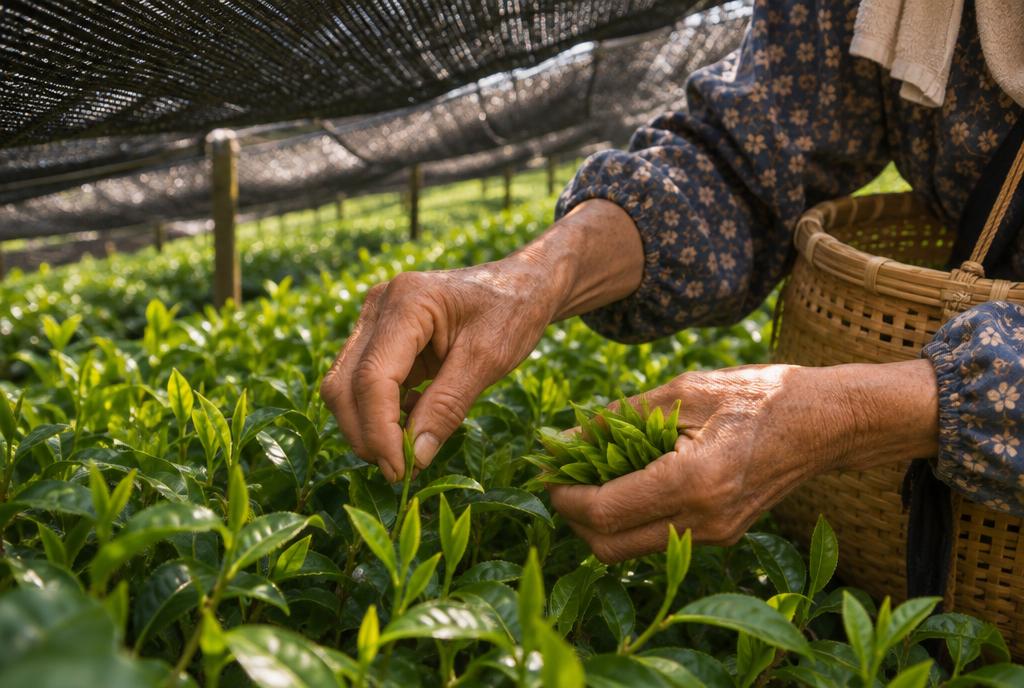
The finest matcha comes from the first harvest of spring, and only the youngest leaves are used. Plucking for top grades is often done by hand for precision. There is one such harvest a year. Later harvests exist, but their leaves are tougher and more astringent, which is why they usually go into lower grades.
Processing
After picking, the leaves are steamed, dried and stripped of stems and veins. What remains is a small share of the original leaf. Business Times notes that makers use only a small portion of the tencha for higher grades, so the higher the grade, the scarcer it becomes.
Stone milling
Traditional granite mills turn slowly to keep heat down and protect colour and aroma. Jing Tea notes that a single mill produces around 30 g of matcha an hour. Tokyo Cheapo puts it the same way: an hour of grinding for just 30 grams. That is one small tin, from one mill, in one hour.
Add knowledge built over generations, careful blending and the cost of keeping powder fresh, and good matcha was never going to be cheap. Then demand changed.
The matcha shortage of 2025 and 2026
From about 2024, interest in matcha rose sharply around the world, driven by cafés, social media, travel to Japan and a broader taste for Japanese ingredients. Supply could not follow quickly. Here is what the people closest to the trade have reported.
- New fields take years. Ippodo, the Kyoto tea house, explains that new tea fields take about five years before they can be harvested. In 2025, supply simply fell short of demand.
- Fewer farmers. Tokyo Cheapo reports that the number of tea farmers in Japan has fallen from over 54,000 in 2000 to around 20,000. Kettl notes that producers also cite an ageing workforce, labour shortages and rising costs.
- Weather. Business Times points to heatwaves in Kyoto reducing farm yields.
- Purchase limits. Many shops in Japan limited customers to one tin or packet each, and Tokyo Cheapo found that limits were still in place in Ueno in February 2026.
- Growers switching crops. Ippodo's September 2026 notice says that in 2026 production shifted towards matcha, while gyokuro, sencha and bancha output dropped substantially. It introduced purchase limits on bancha in February 2026.
How much has the matcha price increase been?
The clearest signal comes from Kyoto's spring tencha auctions, where the raw leaf for matcha is traded. Kettl, a US tea company, reports that the average first-flush auction price rose about 169% from 2024 to 2025, close to tripling in a single year. Kettl adds that opening auctions in 2026 were higher again, with industry reporting suggesting a rise of roughly 50–60%, though full-season averages were not yet final.
Those rises flow through to the shelf. Tokyo Cheapo describes one lower-tier tin in Japan selling for more than four times its usual price. In Singapore, Business Times reported that café matcha prices rose by up to 25% between 2020 and 2025. Tea houses have revised too: Ippodo changed matcha specifications and prices in October 2025, and announced further revisions for October and November 2026.
Will prices fall back? Ippodo does not expect them to return to earlier levels. It expects some movement from year to year, with prices broadly similar for some time, while noting that forecasting is very difficult. A reasonable reading is that higher matcha prices are the new normal rather than a short spike.
How to spot a fair price
A high price is not proof of quality, and a low one is not always a bargain. The useful question is what you get for each cup. Here is a calm way to judge value.
Work out the cost per cup
A standard bowl of matcha uses 2 g of powder. A 30 g tin at 2 g a cup makes 15 cups. Divide the tin's price by 15 and you have a cost per cup you can compare with anything else you drink, including a café latte. For lattes, the same 2 g goes in with 30 ml hot water and 150 ml steamed or oat milk, so the matcha share of the cost stays the same.
Check what the price is paying for
A fair price should come with evidence. Look for:
- A named region, such as Uji in Kyoto or Yame in Fukuoka.
- A stated harvest, ideally first harvest.
- Stone milling, or at least a clear description of how it is ground.
- One ingredient: matcha. No sugar, no milk powder.
- Opaque, airtight packaging with a best-before date.
- Independent testing, ideally batch by batch.
Our guide on how to tell good quality matcha walks through each of these checks with simple tests at home.
Match the grade to the drink
You do not need the top grade for everything. For plain bowls and koicha, the extra cost of first-harvest, shade-grown leaf shows directly in the cup. In a milky latte, a sturdier grade can work well. Our explainer on ceremonial vs culinary matcha covers which suits what, and our matcha latte method shows how to get the most from each gram.
Watch for warning signs
Shortages invite shortcuts. Be cautious of "ceremonial" matcha priced far below everything else, labels with no region or harvest, and blends sold as pure matcha. Business Times also reported counterfeit matcha appearing online in packaging that copies Japanese brands. Buy from sellers who can tell you where the tea was grown and how it was tested.
Value at a glance
| What you see | Usually fair value | Look closer |
|---|---|---|
| Origin | Region named, such as Uji or Yame | Only "premium" or "Japanese style" |
| Harvest | First harvest stated | No harvest given |
| Milling | Stone-ground | Not stated |
| Ingredients | Matcha only | Sugar, milk powder, "green tea powder" |
| Testing | Independent, per batch | No information |
| Price | In line with similar named-origin matcha | Far below the market for "ceremonial" |
| From Matcha x World | RIN, our first-harvest stone-milled matcha from Uji. Add RIN to cart | |
How we think about it at Matcha x World
We source from Japan and name the region behind every matcha we sell. Every batch is independently verified by SGS, and you can read how on our lab-tested quality page. No sugar, no flavourings, no fillers. Our view is simple: when matcha costs more, it should taste like it, and you should be able to see why.
Whatever you buy, protect it once it is open. Keep cool and dry. Enjoy within a month of opening. Stale matcha is the most expensive kind, because you end up not drinking it.
Frequently asked questions
Why is matcha so expensive compared with other green tea?
Matcha leaves are shaded for weeks, picked young in spring, de-stemmed and slowly stone-ground, with one mill making around 30 g an hour. Since 2024, demand has also outpaced supply.
Is the matcha shortage still going in 2026?
Yes, according to Ippodo, which reported in September 2026 that growers shifted towards matcha, cutting other teas, and announced price and specification revisions for October and November 2026.
Will matcha prices go down?
Ippodo does not expect prices to return to earlier levels, though it expects year-to-year movement. New fields take about five years to harvest, so supply grows slowly.
Is cheap matcha bad?
Not always, especially for baking or lattes. But very cheap "ceremonial" matcha with no region, harvest or testing is worth questioning, particularly during a shortage.
Which Matcha x World matcha is good value for drinking plain?
For plain bowls, RIN from Uji, Kyoto is the one we recommend first: first harvest and stone-milled, with rounded umami, a creamy body and very little bitterness, so you taste what the price is paying for. For koicha, KIWAMI from Yame is the step up.
Drink it slowly
Good matcha costs more because it takes more: more shade, more hands, more time at the mill. The best way to honour that is to prepare it well. Whisk 2 g with 70 ml of water at about 80°C in a W motion for 15–20 seconds, and taste what the price is paying for. Our guide to preparing matcha at home covers hot, iced and latte methods.

For koicha and special bowls
KIWAMI 極 · Yame, Fukuoka
A rarer first-harvest tin from Yame, Fukuoka, for koicha or a plain bowl on a special occasion.
Calm Energy. One World.