The traditional matcha ceremony: its history and ritual
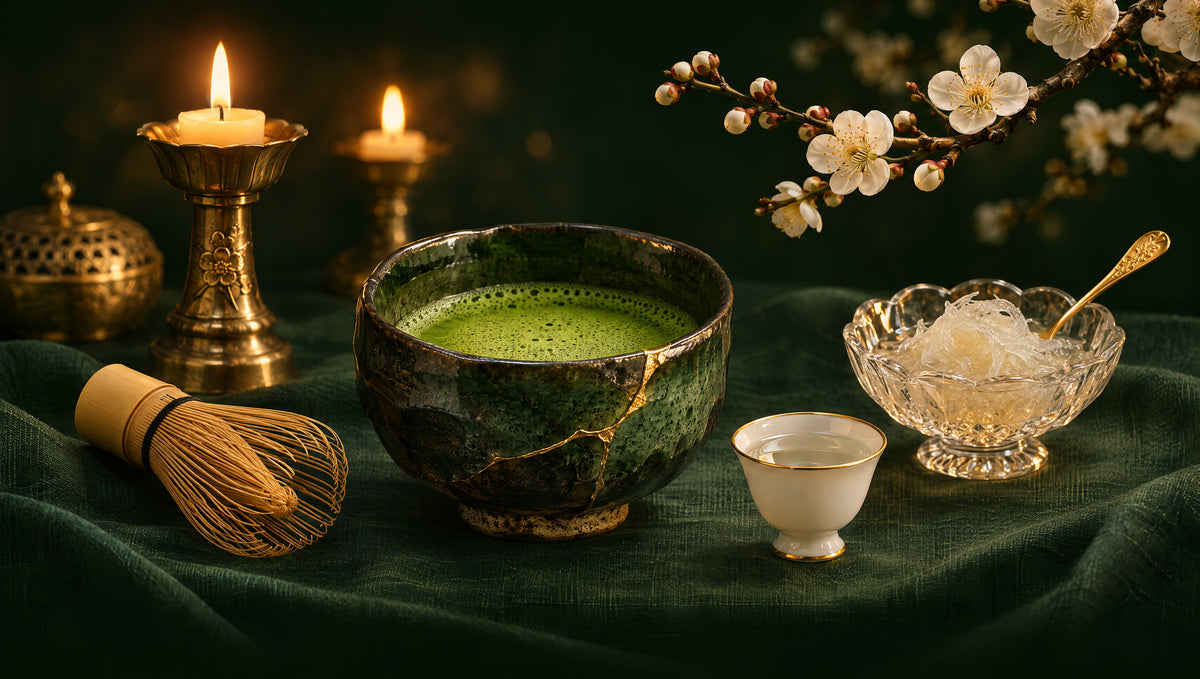
When you have more time, the same bowl becomes a ritual. Here is the history behind the traditional matcha ceremony, the four principles that still shape it, and the ritual itself in seven unhurried steps.
The history in the bowl
Matcha was never a trend. For centuries it was whisked slowly, by hand — a daily cup made with care and quiet gratitude. Four hundred years ago the tea master Sen no Rikyū turned it into an art, stripping away every ornament until only presence was left. He named four principles, and they still shape every bowl worth drinking.
Wa · Harmony 和
Between you, the season, and the people you pour for.
Kei · Respect 敬
For the leaf, the tools, and the hands that shaped them.
Sei · Purity 清
A clean bowl, a clear mind — nothing you don't need.
Jaku · Tranquillity 寂
The stillness the first three principles leave behind.
Rikyū's way of tea is often described as wabi-sabi — beauty in the imperfect and unfinished. Nothing to prove, nothing to perfect. Just this bowl, right now.
The traditional ritual, step by step
The movements are only half of it — what turns preparation into ritual is the heart you bring to it. Seven unhurried steps for usucha, thin tea, whisked light — a small space set apart to give thanks.
You will need: 2 g of matcha, 70 ml of water at about 80°C, a chawan (tea bowl), a chasen (bamboo whisk) and a fine strainer.
01 · Begin with thanks
Clear a small space and settle. Before you touch the tea, pause to give thanks for the day and the cup before you. The ritual begins the moment you choose to be present.
02 · Warm the bowl and whisk
Pour hot water into the chawan and let the chasen soak about 3 minutes to soften the bamboo prongs. Discard the water and dry the bowl — moving slowly, breathing easy.
03 · Sift the matcha
Sift 2 g, two level 1 g spoons, through a fine strainer straight into the bowl — the step most people skip, and the one that prevents clumps. Breathe in the fresh, grassy aroma as it falls.
04 · Pour at the right heat
Add 70 ml of water at about 80°C — never boiling, which scorches the leaf and turns it bitter. Exhale, slowly, as you pour.
05 · Whisk quick and light
Whisk in a quick W from the wrist, just off the bottom, for 15 to 20 seconds. Let the sound and rhythm settle you into a calm, grateful attention — until a fine, light-green foam forms and the mind grows quiet.
06 · Meet every sense
Pause before you drink. The vivid green, the whisk still ringing, the grassy-sweet aroma, the warmth in your palms — notice each one in turn.
07 · Sip, and give thanks
Drink while the foam holds — usucha at its best, light and alive. Give thanks for the harvest, for the farmers who grew the leaf and the makers who shaped your bowl, and for the gift of the pause.
Some mornings you'll have five minutes, some thirty — both are complete. Let it be a small sabbath in the middle of the day — a moment to be still and grateful — and that's what keeps it for life.

For the ceremony
KIWAMI 極 · Yame, Fukuoka
The pinnacle. Best as a hot bowl, straight, and for the connoisseur, koicha (thick tea). For slow mornings, try RIN 凛 from Uji, Kyoto.